Reproductive Rights and the UN’s 2024 Population Projections
Every person has the right to decide freely whether and when to have children, with access to voluntary family planning, healthcare and education, and freedom from pressure or coercion. The UN’s projections describe possible demographic change; they do not prescribe family choices or establish a goal for population size.
Population Projections
World Population Prospects 2024 is the most recent set of projections from the United Nations Population Division (UNPD), released every two years. While other organisations also make detailed population projections, the UN’s have traditionally been seen as the most authoritative and have a good track record of accuracy on the global scale.
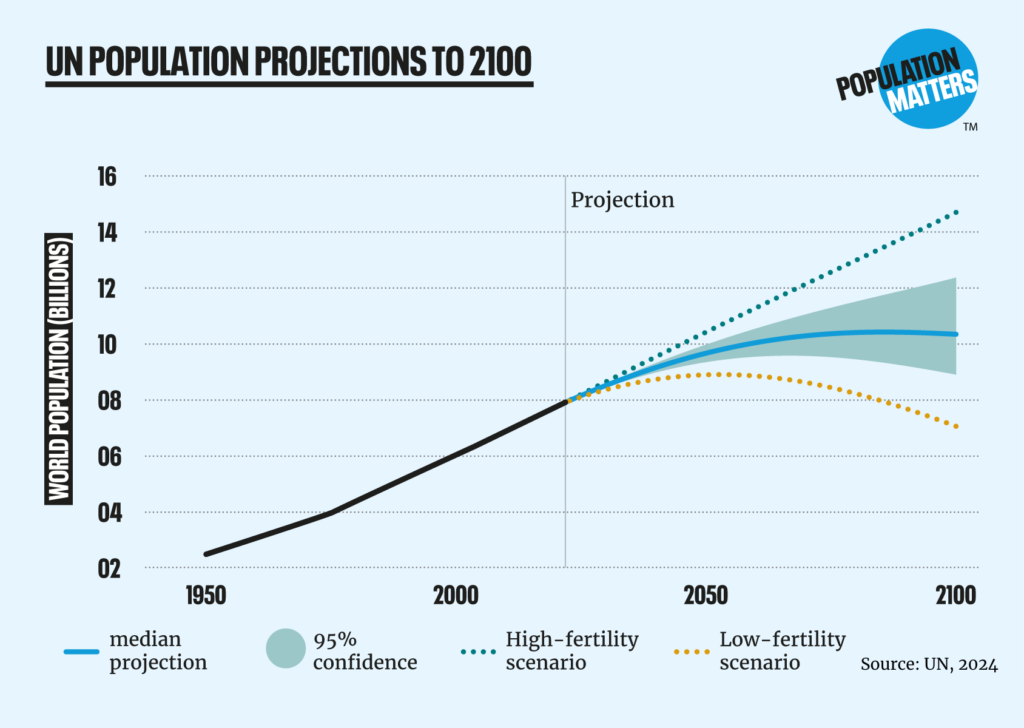
Its most likely projection (called the medium variant) is for a population of 8.5 billion in 2030, crossing 10 billion by 2061, with the global population peaking at 10.3 billion in the mid-2080s. After peaking, the global population will plateau and then gradually decline.
The projected peak of global population was revised slightly lower in the 2024 prospects compared with the previous 2022 prospects.
For context on why other modelled results differ, read our projections explainer; see our population facts and figures page for dated estimates and charts.
Population Growth Continues
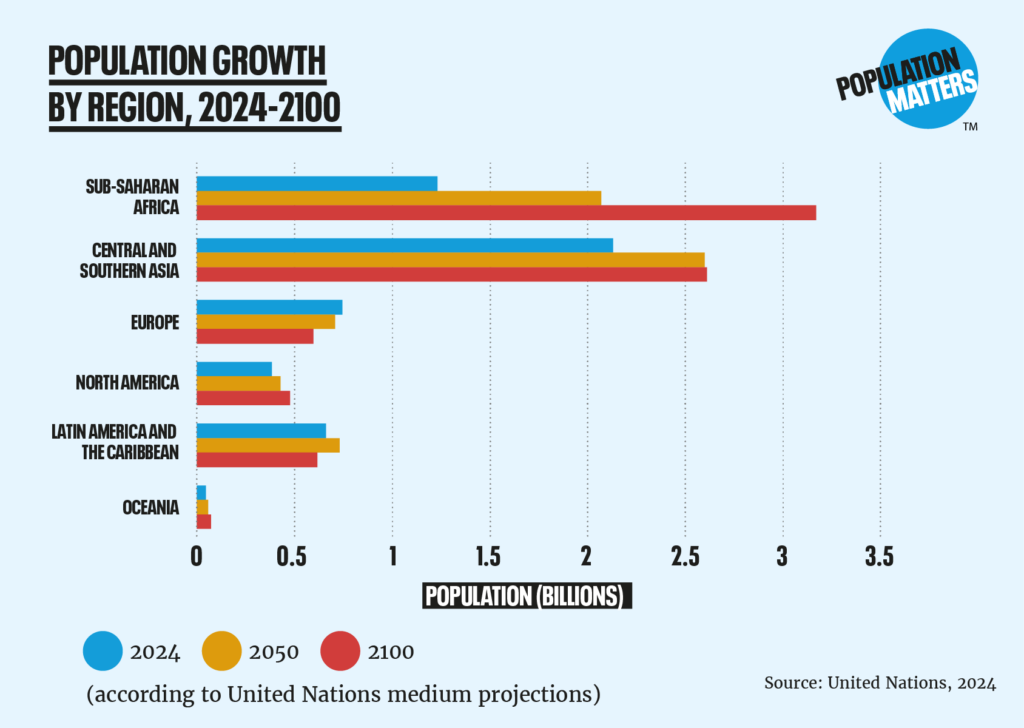
Despite news headlines of a “baby bust”, the UN’s latest projections make it clear that the global population will continue growing. By the end of the century, there will be over two billion more people than we have today, an amount more than five times the size of the population when Population Matters’ patron Sir David Attenborough was born.
The UN predicts that most of this future population growth will be from population momentum. Population momentum is growth that is “baked in” due to high fertility in the past which means there are now more people of reproductive age than before. Despite there now being a lower fertility rate, a larger proportion of people of reproductive age makes some growth inevitable.
The momentum of past growth that is embedded in the youthful age structure of today’s global population is projected to contribute 79 per cent of the total increase through 2054, or around 1.4 billion people.”
UN Population Prospects 2024
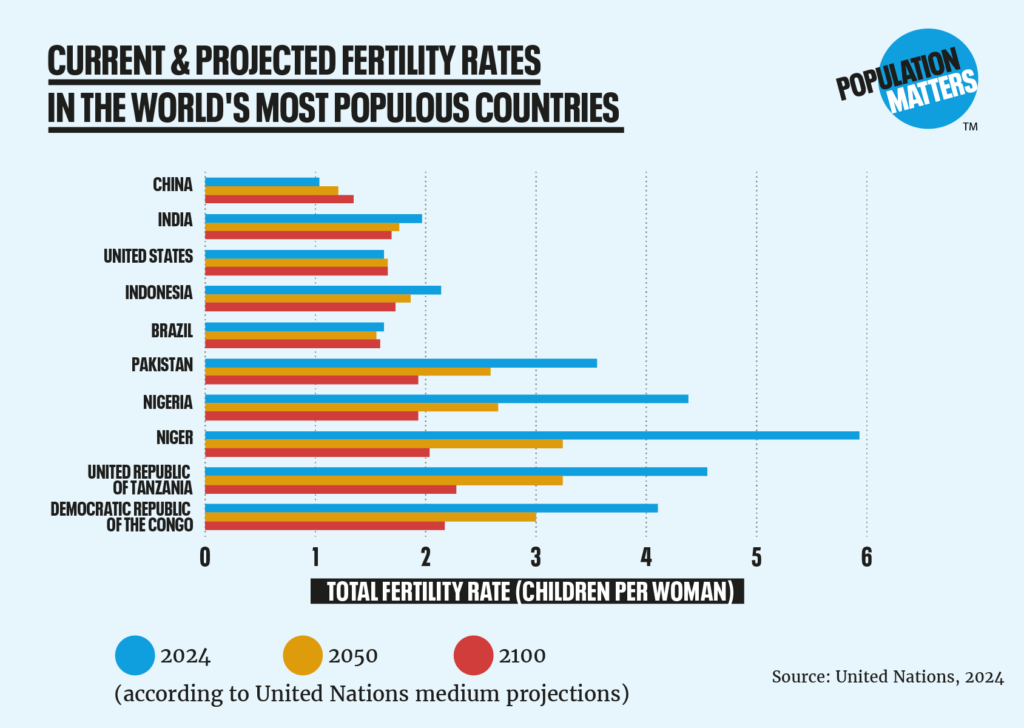
Future population growth will also be driven by high fertility rates in the Global South. Over one in ten countries – mostly in sub-Saharan Africa – have fertility levels of four births or more per woman.
Population growth entrenches poverty
In countries including Angola, the Central African Republic, the Democratic Republic of Congo, Niger and Somalia, high population growth will continue, with populations doubling between 2024 and 2054.
Rapid population growth can make sustainable development more difficult. In its previous 2022 World Population Prospects the UN stated high population growth can:
…potentially trap communities in a vicious cycle: while economic growth may struggle to keep pace with population growth, poverty can deprive individuals of opportunities and choices, limiting their ability to control their fertility, perpetuating high levels of childbearing often starting early in life and ensuring the continued rapid growth of the population.”
UN World Population Prospects 2022
Environmental justice means protecting everyone’s right to a healthy environment while addressing unequal consumption. Population change influences demand for food and resources, alongside consumption patterns. The environmental effects depend on how land is used and how food and other goods are produced. FAO’s 2019 biodiversity assessment identifies habitat loss and changes in land and water management as threats to biodiversity for food and agriculture. UNEP’s 2024 Global Resources Outlook shows that, on average, material use and climate impacts from consumption per person are higher in high-income countries than in low-income countries. Protecting habitats and changing unsustainable production and consumption systems can reduce these pressures while meeting people’s needs.
UNFPA estimates that 257 million women in developing regions who want to avoid pregnancy are not using safe and effective family planning methods. Voluntary family planning and reproductive healthcare must be accessible so people can exercise their rights and make their own decisions. These services should be supported for their value to people, not as a way to deliver a preferred population or environmental outcome.
The World Will Be Older
Life expectancy is once again on the rise. Globally, life expectancy at birth reached 73.3 years in 2024 and is predicted to reach an average longevity of 77.4 years globally in 2054.
By the late 2070s, the number of people aged 65 or older is projected to exceed the number of children under 18.
This demographic transition will mean many countries will face ageing populations, but as Population Matters’ 2021 report Silver Linings, Not Silver Burdens made clear, concerns about ageing populations tend to exaggerate the extent of the problem and underestimate the availability of practical solutions.
Countries, especially those with populations that have already peaked or will peak in the next decades, should consider leveraging technology, including automation, to improve productivity at all ages, design more opportunities for life-long learning and re-training, support multigenerational workforces and create opportunities to extend working lives for those who can and want.
UN Population Prospects 2024

Growth from Immigration
The fertility rate is a measure of the average number of children a woman may have over her lifetime. Currently, the global fertility rate stands at 2.25 births per woman.
More than half of all countries and areas globally have a fertility rate below the replacement rate of 2.1 births per woman. The replacement rate is the level required for a population to maintain a constant size in the long run (excluding migration).
Immigration is projected to be the main driver of population growth in 52 countries and areas, including the UK, Australia, Canada and the US, through to 2054.

Guard Against Pronatalism
The UN’s 2024 population prospects state that across the globe, 63 countries’ populations peaked before 2024. This group includes China, Germany, and Japan.
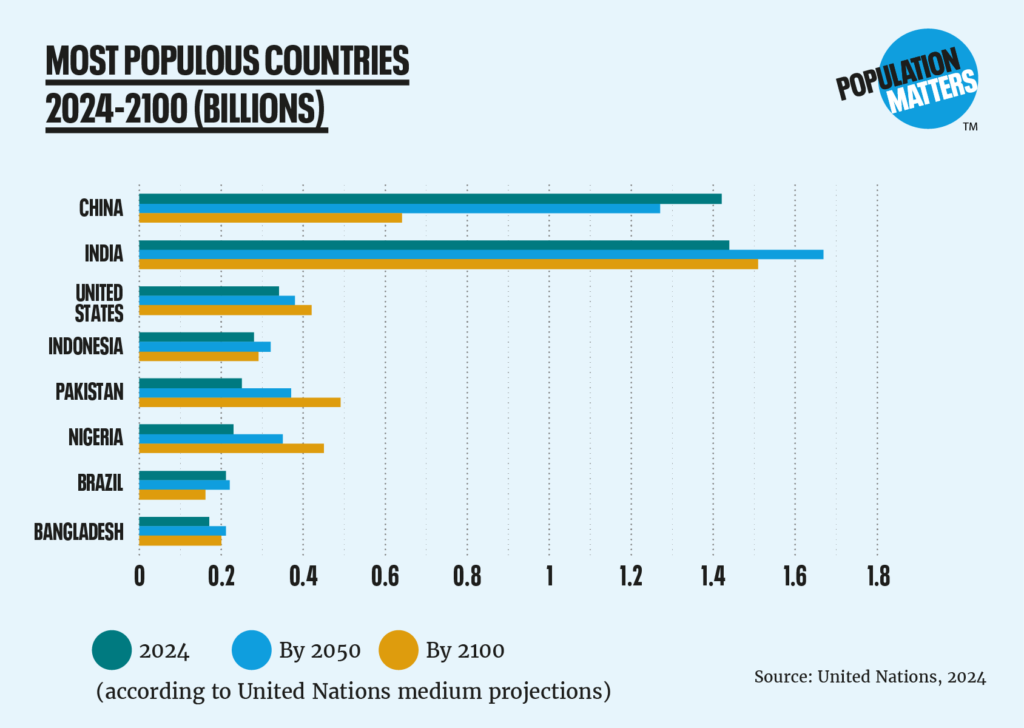
In countries with populations that have already peaked, the number of women in the reproductive age range is projected to shrink by 33 per cent between 2024 and 2054.
This demographic change is important as it will undermine the effectiveness of any pronatalist policies aimed at raising the birth rate.
By the late 2030s, half of the women in countries with populations that have already peaked will be too old to have children by natural means. Because the share of women in the reproductive age range (roughly, between 15 and 49 years) is projected to decline rapidly in such countries, the impact on population size of policies aimed at raising fertility levels is likely to diminish over time.”
UN Population Prospects 2024
To account for this changing demographic, governments should focus on policies to invest in the health and well-being of an ageing population, as opposed to wasting resources on pronatalist policies designed to raise the birth rate.
In addition, as detailed in our Gilead Watch report, pronatalist policies often lead to attacks on women’s rights. Pronatalist policies have been linked to dangerous rollbacks on women’s reproductive rights, restricting women’s access to contraceptives and their right to access safe abortions. Therefore, policymakers must steer away from falling into the trap of pronatalism, and instead focus on adapting to and investing in a changing demographic.
Gender Inequalities Persist
In 2024, 4.7 million babies, 3.5 per cent of the total worldwide, were born to mothers under age 18. Of these some 340,000 babies were born to girls under age 15, with adverse health effects for both the young mothers and their children.
This is reflective of the crisis in SRHR funding, with 257 million women worldwide having an unmet need for contraception.
Social and legal barriers often prevent women and young girls from making autonomous decisions about their sexual and reproductive health, including limiting their access to safe, modern contraception, resulting in areas with populations that are growing rapidly.
Girls are also more likely to be denied schooling so they can work, get married young and have large families, rather than learning, working and earning a decent income. Education is the key to higher incomes and to breaking the cycle of poverty.
Girls’ rights to health, education and freely chosen futures are ends in themselves. In a modelled scenario with no births to girls under 18, UN DESA projects the population of sub-Saharan Africa in 2054 would be 3.8 per cent smaller than in its medium scenario. This is a scenario, not a policy target or a reason to restrict anyone’s choices.
“Increasing the age at first childbearing contributes to slowing population growth, reducing the scale of future investments needed to cater for a growing population and minimising the corresponding environmental impacts of a large population.
UN Population Prospects 2024
Continued high fertility rates are a sign of all the young girls and women that are being left behind, due to gaps in sexual and reproductive healthcare (SRHR) funding, and lack of progress in breaking down barriers to girls pursuing higher education and careers.
Final Thoughts
Reproductive rights and bodily autonomy are goals in themselves. Demographic projections can support evidence-led planning, but neither a particular population size nor a change in fertility is a goal. We must discuss population trends alongside unequal consumption, production systems, technology, policy, inequality and historical responsibility.