
Climate change
Climate change has caused widespread harm to nature and people. The IPCC finds that the highest-emitting 10% of households contribute 34–45% of global consumption-based household greenhouse gas emissions, compared with 13–15% from the bottom 50%. Rapid emissions cuts are needed to reduce future climate risks. Everyone also has the right to make decisions about their own body and whether or when to have children. Access to reproductive healthcare, education and voluntary family planning must be secured because these are rights in their own right, not climate policies or tools for changing population numbers. Population trends can inform long-term planning alongside evidence about production, consumption, technology and policy; they never transfer responsibility for climate change onto people because of where they live or the choices they make about family.
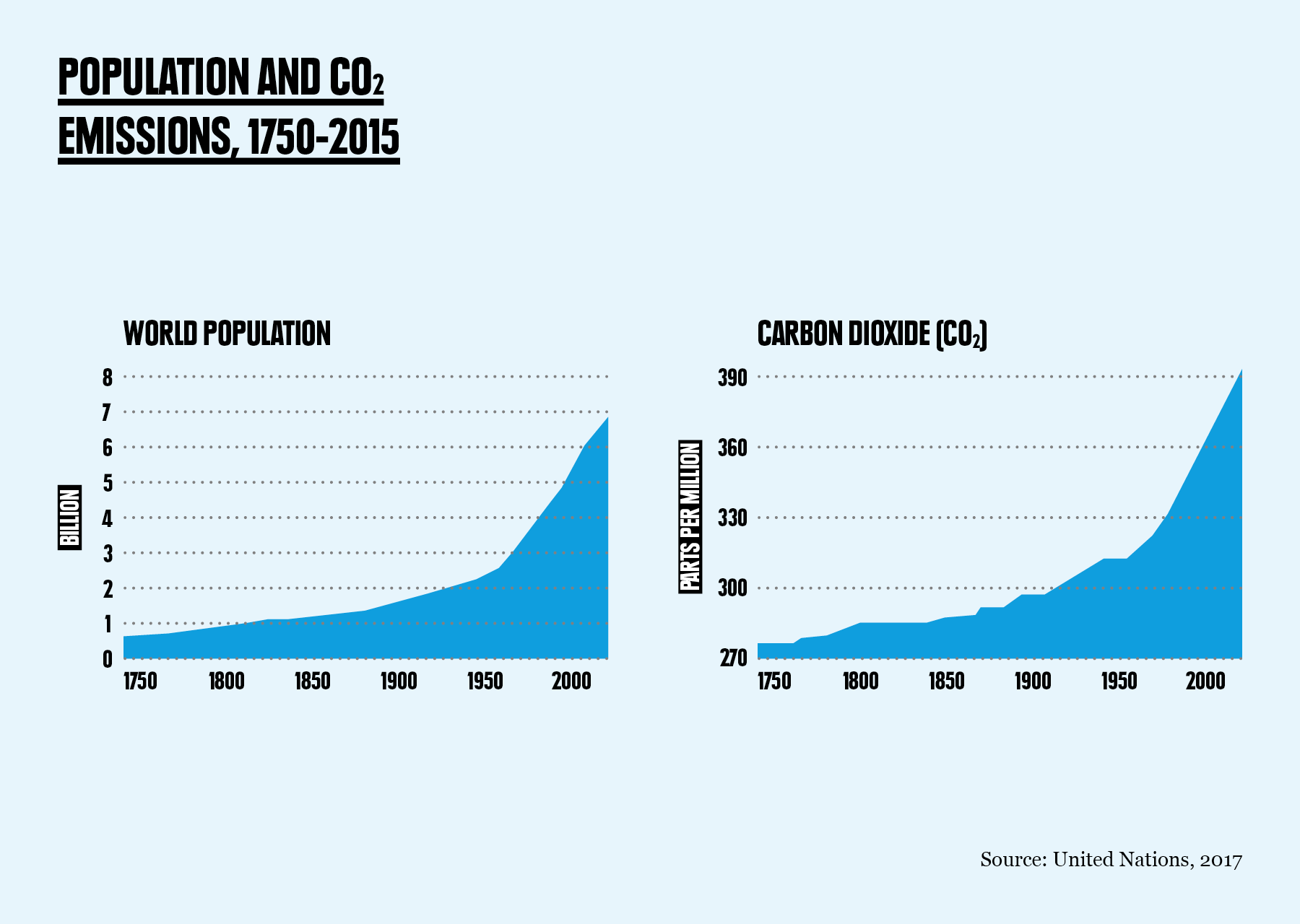
Globally, gross domestic product (GDP) per capita and population growth remained the strongest drivers of CO₂ emissions from fossil fuel combustion in the last decade (high confidence).
– Intergovernmental Panel on Climate Change, Sixth Assessment Report, Climate Change 2022: Mitigation of Climate Change
Climate and emissions outcomes reflect interacting systems, including energy, production, land use, policy and consumption. Population trends can inform planning, but they do not transfer responsibility for climate change to individuals or communities.
Demographic projections can inform long-term planning. UN DESA’s 2024 projections put global population at around 10.3 billion in the mid-2080s, before easing to about 10.2 billion by 2100. These are estimates, not targets or prescriptions for individual or family choices.
The climate crisis
Further warming of our atmosphere is now impossible to avoid. The effects of that warming will depend on how high and how fast the temperature rises. Global warming changes weather patterns, causing severe weather events, heatwaves, droughts and floods.
Climate change is already shrinking glaciers and ice caps, altering the availability of fresh water. It contributes to ocean acidification, destroying coral reefs and other aquatic ecosystems. It makes places uninhabitable for some plants and animals, leading to extinctions and redistribution of species, threatening food production with alien pests and diseases.
For many people in the world, the impacts of climate change are already here: extreme weather events like the Australian bushfires and floods in Kenya devastate lives, while critical impacts on agriculture such as through soil degradation and unseasonal weather lead to unpredictable and unstable crop yields – especially dangerous for the poorest.
Its potential human cost is catastrophic. A rise in sea levels threatens hundreds of millions of people in coastal communities and cities across the globe. Food and water shortages and conflict over productive land will arise, while progress in global health could be rolled back by communicable diseases such as malaria reaching places they never existed before. Hundreds of millions of people are likely to be forced to migrate from their homes by 2050.
Climate change action
Reproductive rights and bodily autonomy are ends in themselves. Climate action must not use family choices as policy tools; it should focus on emissions and unequal consumption. Explore sustainable consumption and global justice.
Climate action should focus on rapid emissions cuts and the systems that drive emissions. Reproductive healthcare, education and voluntary family planning are essential rights, not climate policies or methods for changing population numbers.
Chaurasia’s 2020 decomposition study examined global changes and separately analysed 44 countries from 1990 to 2019. For the world overall, it estimated that population-attributed increases offset more than 77 per cent of fossil-fuel CO₂ emissions reductions attributed to lower energy intensity and lower carbon intensity. The analysis is an accounting decomposition; the global estimate is not a result for the 44 countries individually or collectively. Meanwhile, solutions such as reforestation may be more difficult to implement with more people needing food and land. In its 2018 Special Report, the IPCC identifies lack of global cooperation, governance of the required energy and land transformation, and increases in resource-intensive consumption as key impediments to 1.5°C pathways. It notes that governance challenges have been related in the pathway literature to scenarios with high inequality and high population growth.
Reproductive rights and family planning services are essential in their own right, and must not be framed as climate interventions.
Rights can be supported through positive actions which empower people and improve lives.
Global policy
Reproductive rights, bodily autonomy and voluntary family planning matter in their own right. They must not be limited or instrumentalised to achieve population or climate targets. The 2019 BioScience paper ‘World Scientists’ Warning of a Climate Emergency’ is a historical climate-policy statement; its authors wrote that ‘the world population must be stabilized—and, ideally, gradually reduced’, alongside calls for family-planning access and gender equity. Population Matters rejects that population-size target. The paper also identifies excessive consumption by wealthy lifestyles as a climate driver; climate action must address emissions and unequal consumption directly.
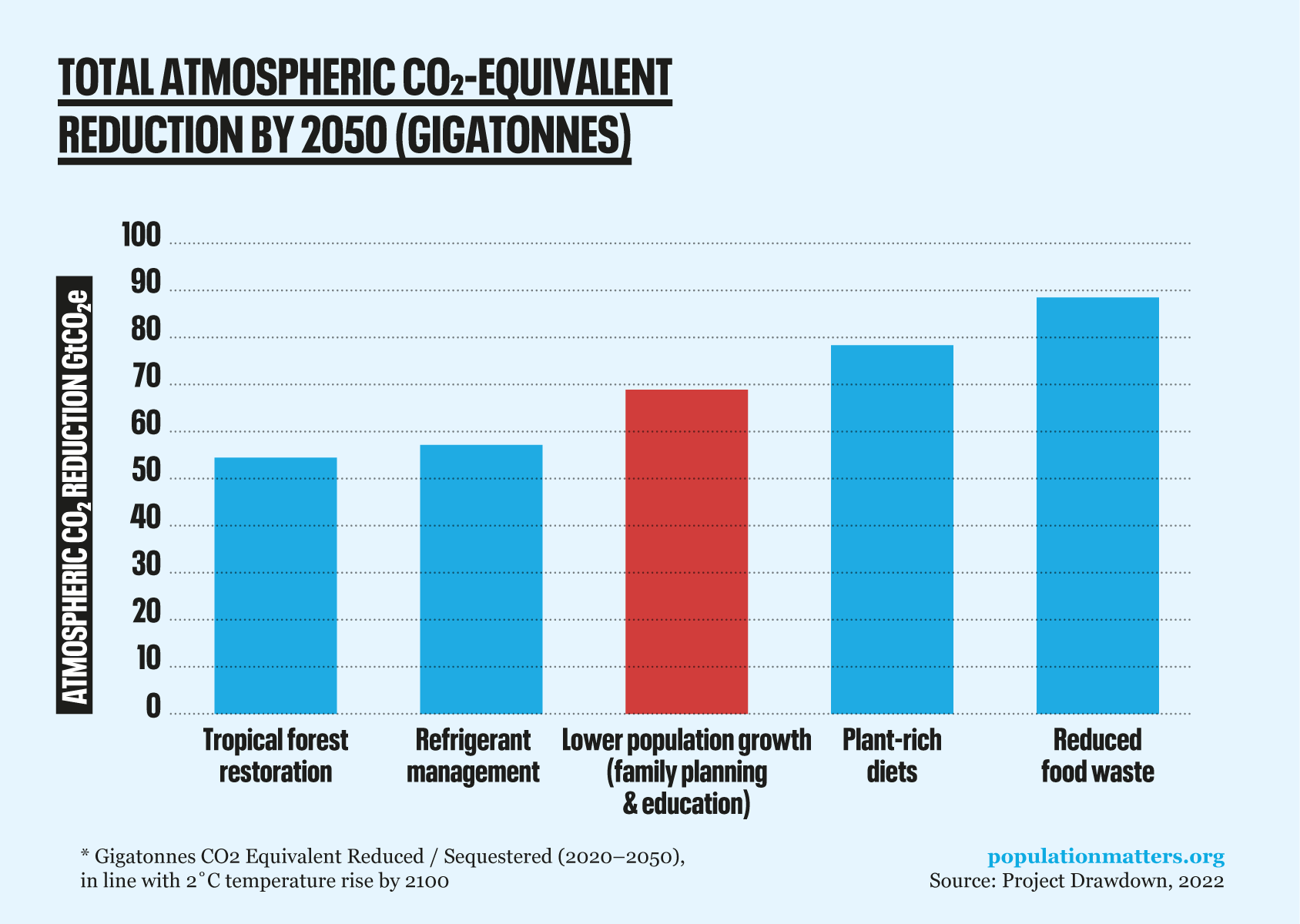
Project Drawdown’s 2022 Health and Education policy brief describes universal education and voluntary family planning as human rights. It models a high-adoption scenario using 2019 UN population data; the scenario is an analytical model, not a forecast or a population target.
In that high-adoption scenario, the brief estimates nearly 70 GtCO₂e in emissions reductions associated with economic development and activity through 2050. Project Drawdown notes that global links are complex and that regions with high population growth are among the lowest greenhouse-gas emitters.
Girls’ and women’s education is a right. It must not be used to pressure people about family choices or as a climate intervention. Climate action should focus on cutting emissions and addressing unequal consumption.
Population Matters
Reproductive rights, bodily autonomy, girls’ education and voluntary family planning are rights in their own right. Project Drawdown’s 2022 Climate–Poverty Connections report notes that family planning and education are not, in themselves, climate-mitigation strategies. Climate action should focus on cutting emissions and addressing unequal consumption.
A message for COP26 delegates
We asked Sara Lara, Founder of Population Matters’ Empower to Plan partner Women for Conservation, about the importance of family planning and girls’ education for the climate and environment, and what she wants delegates at COP26, the crucial climate conference, to know. Women for Conservation work to provide women and girls in rural Colombia with access to sexual and reproductive health services and engage communities in conservation efforts.
high consumption in the global north
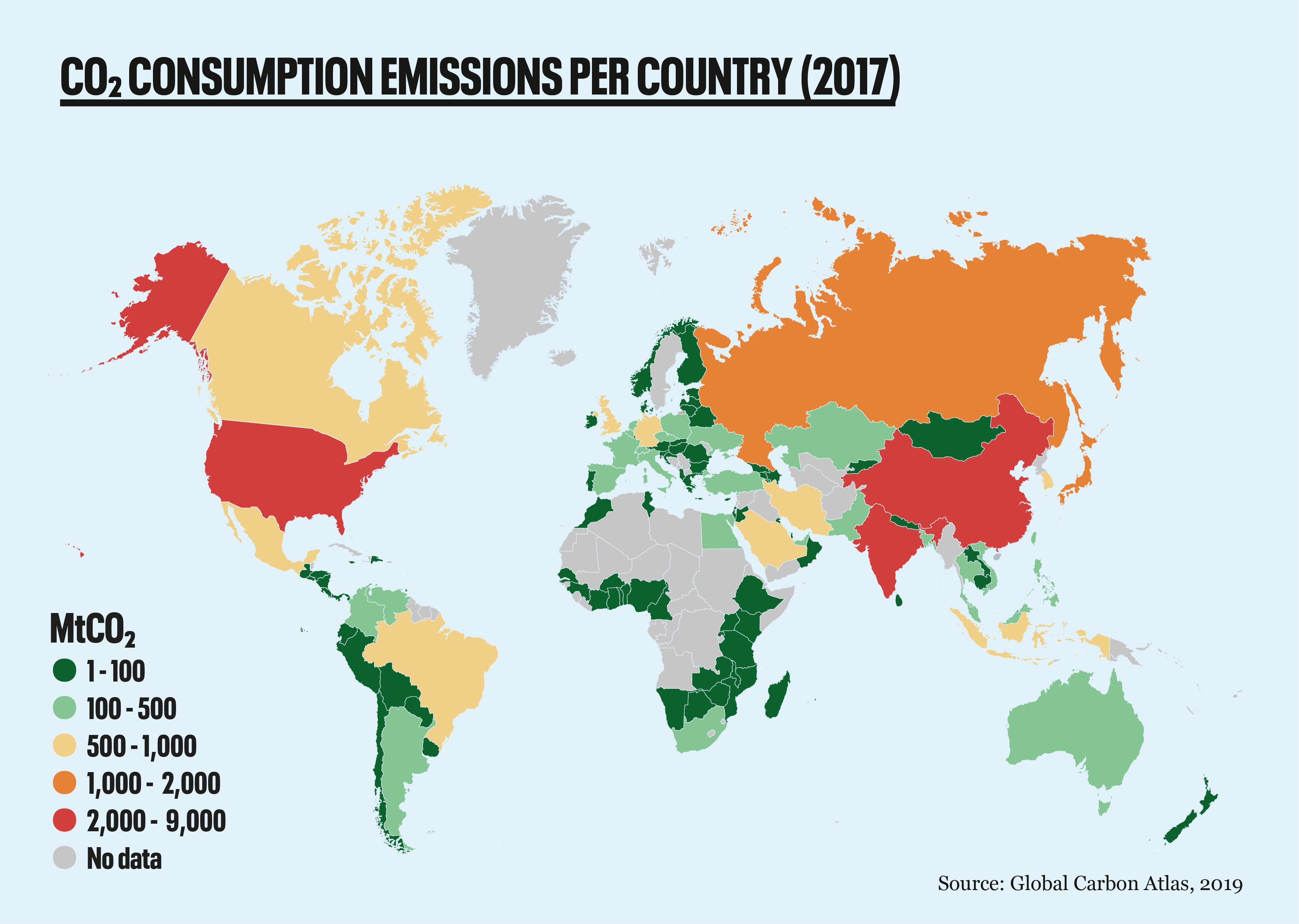
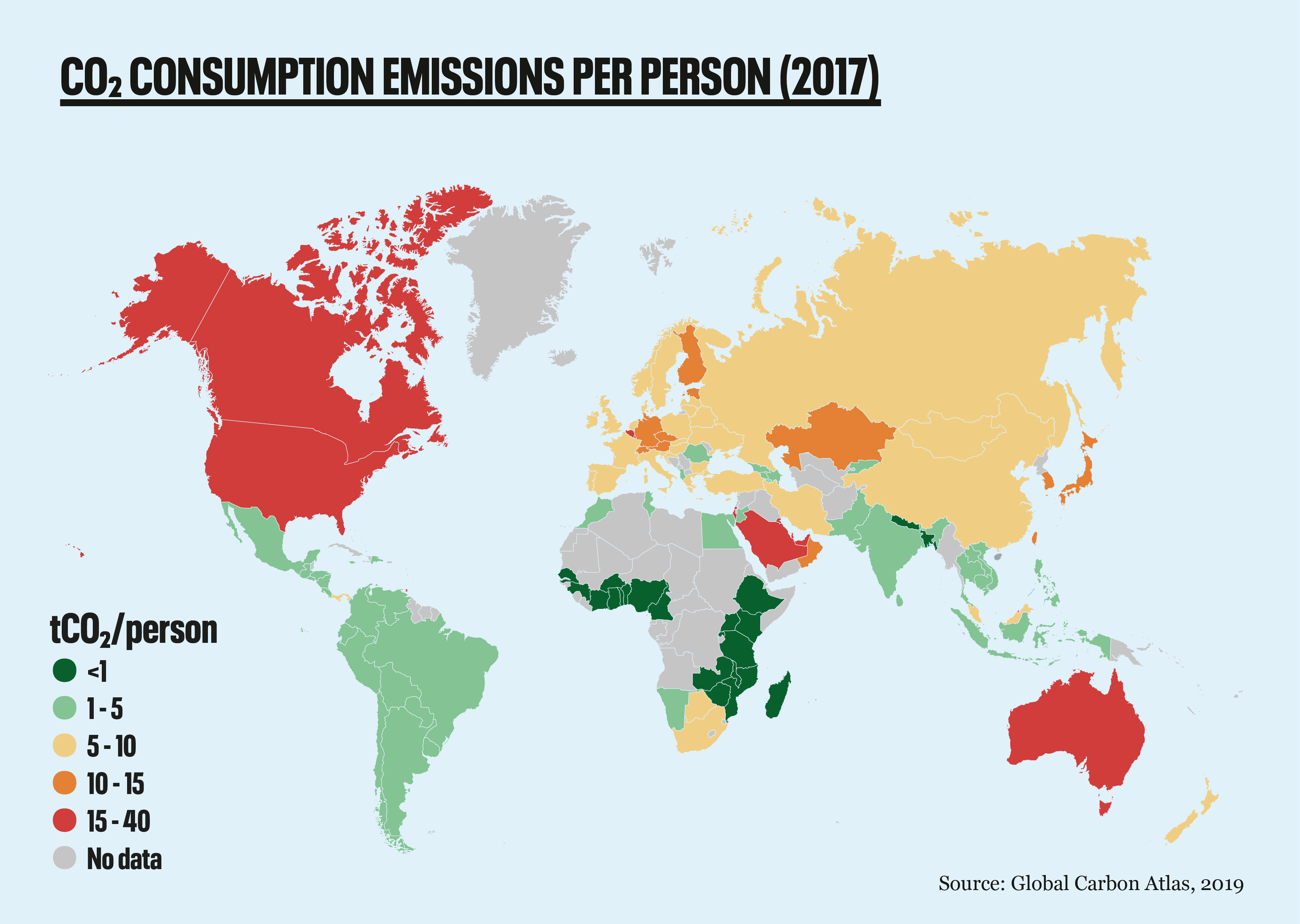
Everyone has the right to a decent standard of living and economic development. Oxfam and SEI’s 2020 analysis estimated that, in 2015, the richest 10% of the global population accounted for 49% of global consumption emissions, while the poorest 50% accounted for 7%.
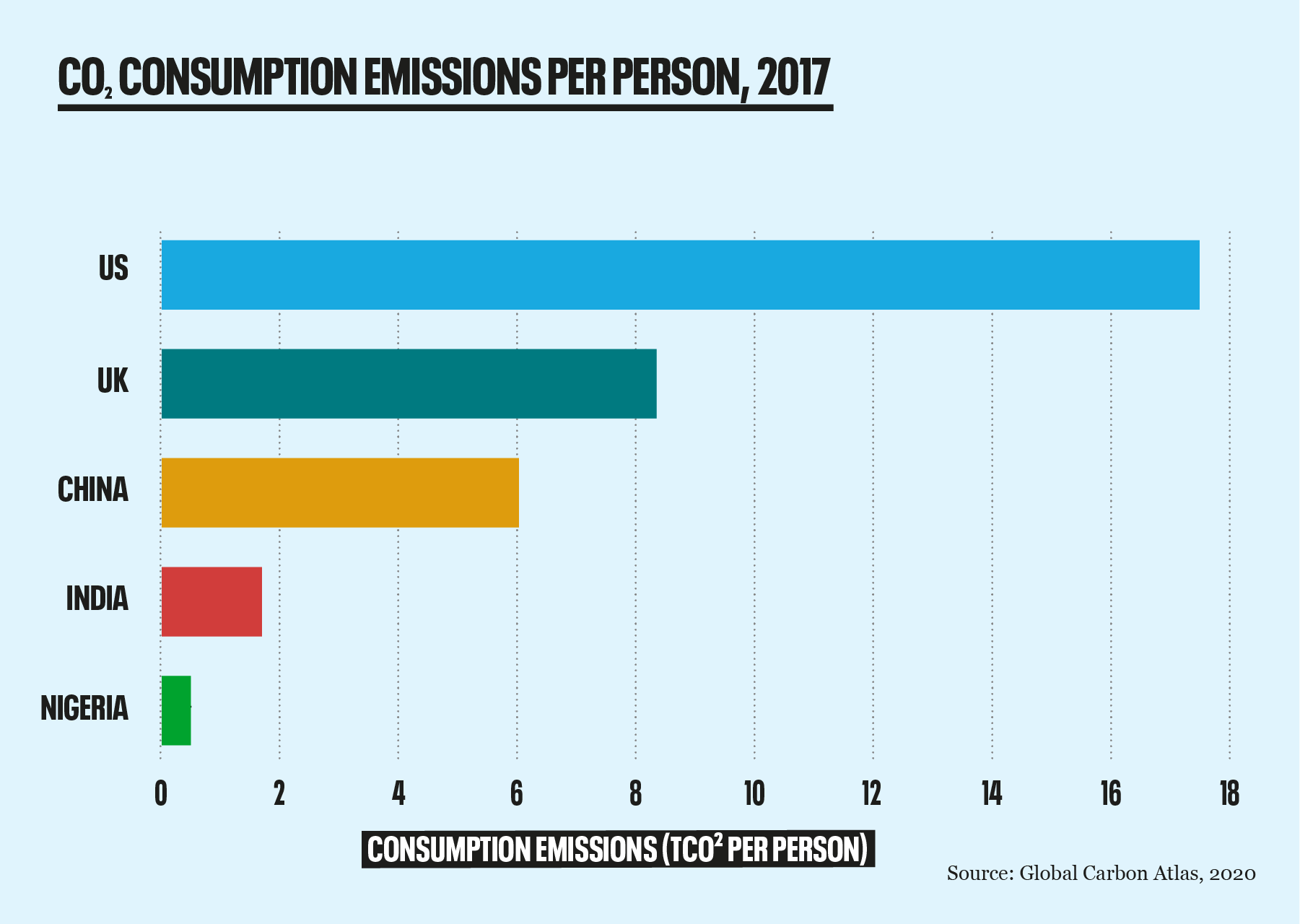
These figures describe global income groups across 117 countries; they are not emissions totals for residents of any one country.
Everyone has the right to economic development. The UN’s 2020 SDG 13 report said greenhouse-gas emissions from developing countries rose by 43.2% between 2000 and 2013, largely attributable to increased industrialisation and economic output. This historical comparison does not establish a population-growth effect; climate action should support equitable development while cutting emissions.
People living in poverty have an absolute right to economic development. Climate action must not keep people poor or treat their reproductive choices as a means to achieve a climate or population outcome. Climate policy must address high consumption and the systems that drive emissions, while supporting rights and access to healthcare and education.
The world’s most populous nations, India and China, are among the top contributors to climate change overall, despite lower impacts from each individual than in wealthier countries. While population growth in India and China is now relatively low, people born today in countries whose populations are still expanding rapidly will have a climate impact for generations to come. Climate policy should address emissions and unequal consumption directly, while respecting rights and supporting fair access to development and healthcare.
Reproductive rights and fair climate action
Reproductive rights, bodily autonomy, quality education and voluntary family planning are ends in themselves. Everyone must be free to decide whether and when to have children, without pressure or coercion. Climate action must address unequal consumption and the systems that drive emissions. No climate or population target can justify limiting anyone’s rights.
Read our latest news about climate change
You can find all the latest updates on this topic at the link below.

Reproductive rights and bodily autonomy must be respected in climate action. Climate policy must cut emissions and address the systems that drive them.
Related content

Learn more
Our Population Explorer is a fun, interactive online tool that allows you to access information and key data about the relationship between population and climate change. Click the button above to check it out.